

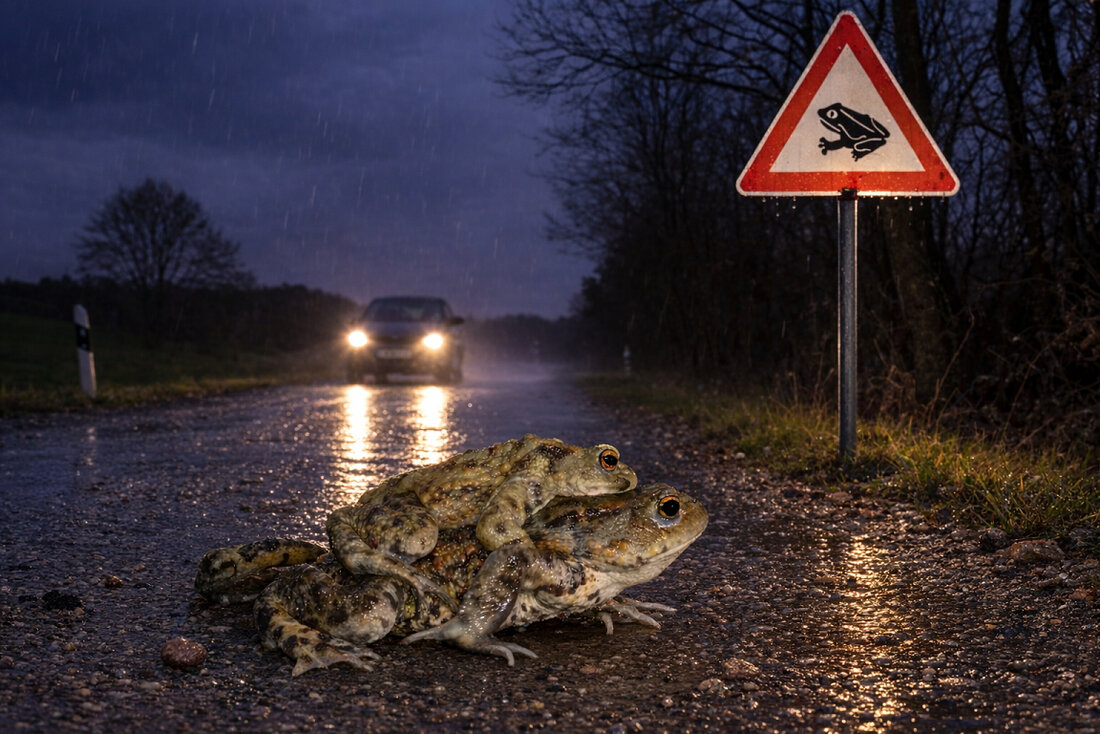
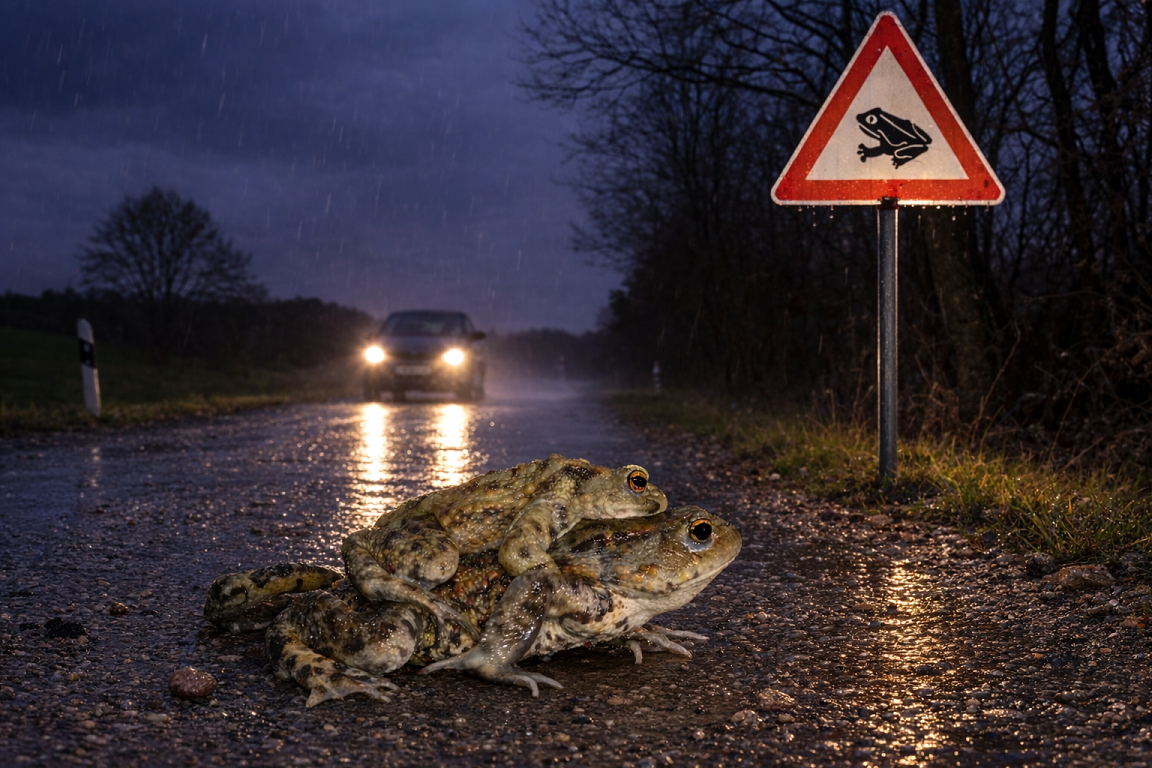
In the coming weeks until around the end of April, the Environment Agency is asking for increased caution in road traffic with the "Attention amphibian migration" signs. This is because as soon as the evening temperatures exceed 4 degrees and there is rain, migrating amphibians can be expected at dusk and at night.
Road traffic is a major source of danger for migrating amphibians and, in addition to habitat loss, land management that is hostile to amphibians (e.g. robotic mowers), drought and unbalanced fish stocking in spawning waters, is also largely responsible for the noticeable decline in amphibian numbers.
A total of 27 amphibian migration hotspots throughout Chemnitz will be marked with "Attention amphibian migration" traffic signs.
Motorised road users are asked to drive at a reduced speed (max. 30 km/h) and with due consideration in these sections in order to protect one of the most endangered species groups. At higher speeds, the negative pressure created under the travelling car is already fatal for the animals - even if they are not run over directly.
Background:
The native frogs, toads and newts belong to the class of amphibians, which spend their lives both on land and in water. A special feature of their way of life is that they visit different habitats depending on the season and migrate between them.
Ten different species have been recorded in the city of Chemnitz. All of these amphibian species are dependent on bodies of water for their reproduction. The animals leave their hibernation sites (e.g. cavities under roots, in the ground, in mud) after hibernation in spring and make their way to their spawning waters. Depending on the species, they cover distances ranging from a few hundred metres (e.g. newt) to three kilometres (e.g. common toad). All native amphibian species are legally protected under the Federal Species Protection Ordinance.
In order to avoid or minimise losses along the known migration routes that are crossed by roads, the Chemnitz Environment Agency is taking various approaches with the support of other agencies and volunteers:
At the main points of conflict, stationary amphibian protection structures have been subsequently erected on existing roads (e.g. Röhrsdorfer Straße, Eubaer Straße, Stiftsweg), which enable amphibians to cross under the road culverts independently and safely.
When new roads are built, such facilities have already been planned where migration movements have been proven (e.g. Südring, extended Kalkstraße).
Mobile amphibian protection fences are used where it is not possible to erect a stationary amphibian protection facility for structural or economic reasons. The fences erected especially for the amphibian migration period prevent the animals from reaching the road and being run over. The animals are intercepted with dug-in buckets and then carried safely across the road by volunteers.