

Chemnitz model - Stage 4: Centre ring
Start of construction on 2 February 2026

On 2 February 2026, the starting signal was given for one of the largest infrastructure projects in Chemnitz's recent history: construction of the Chemnitz rail ring began at Falkeplatz and in Mühlenstraße. It is also the first section of the future railway line to Limbach-Oberfrohna (Chemnitz Model Stage 4 - CM 4 for short). The VMS and its partners, Chemnitz City Council and CVAG, are responsible for the construction.
What will happen in the next few months
The expansion of CM 4 in the Brückenstraße and Theaterstraße area also has an impact on the Mühlenstraße branch. Here, Mühlenstraße needs to be adapted over a length of approx. 170 m to the new Brückenstraße/Theaterstraße junction. As the traffic facilities in the Mühlenstraße area from the Brückenstraße junction to the south of the municipal swimming pool show numerous signs of damage, the City of Chemnitz has decided to utilise synergy effects here and completely renew Mühlenstraße in this area. During construction, the existing traffic area will be divided up with new widths for the needs of motorised private transport, pedestrians and cyclists as well as for the roadside greenery. The parking lane currently located in the centre of Mühlenstraße will be upgraded in future by laying grass and planting trees. The landward bus stop "Am Stadtbad" will also be made barrier-free.
The Falkeplatz bridge consists of three adjacent substructures. Due to numerous damages to the existing structures, the existing superstructures no longer meet the requirements necessary for the realisation of CM 4 and are therefore not worth preserving for the planned purpose. It is therefore planned to replace the entire bridge structure at Falkeplatz.
Keyword: Level 4
Facts and figures
Facts about the CM4
Facts about the CM4
- The costs for the entire railway line to Limbach-Oberfrohna are in the mid three-digit million range.
- 75 per cent is being provided by the federal government, 15 per cent by the Free State of Saxony and 5 per cent each by the City of Chemnitz and the Central Saxony Transport Association (ZVMS).
- It is a coordinated construction project with eins Energie in Sachsen, the waste disposal company of the city of Chemnitz (ESC) and the city of Chemnitz.
- The Chemnitz railway ring with the route to the Ermafa Passage is expected to be completed in 2030.
- Planning for the route via Leipziger Straße to Chemnitz Centre and on to Limbach-Oberfrohna has been underway since the beginning of 2025.
- The railway line (16 kilometres) is scheduled for completion in the mid-2030s.
- The first step will be to close the centre ring around Chemnitz city centre. The railway tracks can be extended to Konkordiapark and six new stops will be built.
Information on the construction process and traffic information
Construction work and traffic information for cars, cyclists and pedestrians

While the first weeks of February will be used to set up the construction site and carry out preparatory work on Falkeplatz, construction work on Mühlenstraße will start at the beginning of February with a full road closure. Detailed information on the construction process, detailed information and traffic information can be found at www.chemnitzer-modell.de
CVAG: Routing for bus and train

Construction work on Falkeplatz and Mühlenstraße will start on 2 February 2026. During the first construction phase, a so-called construction track will be laid to minimise restrictions on tram traffic for the remainder of the construction period.
Centre ring road: railway connection and upgrading


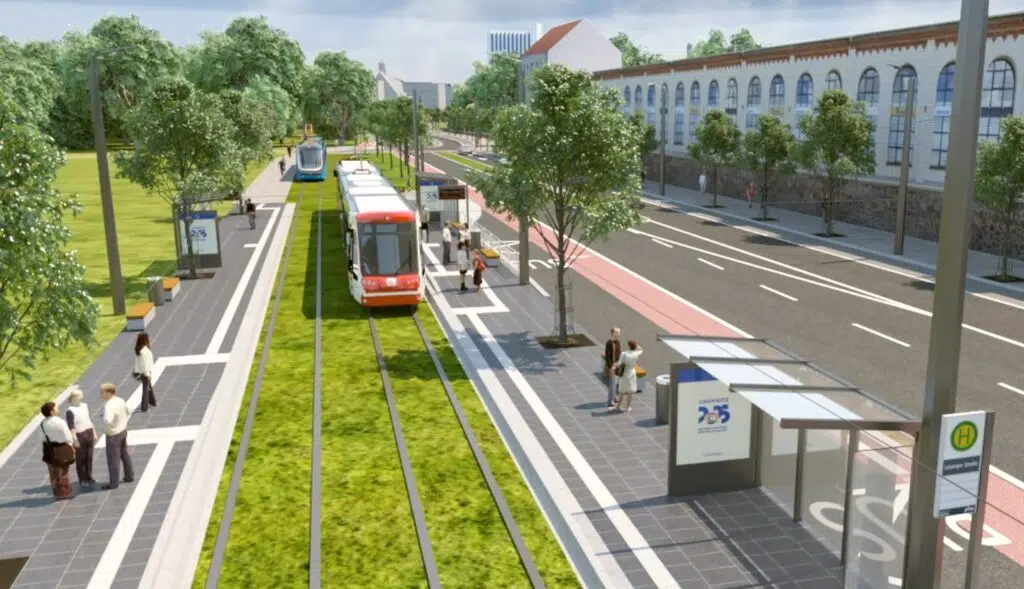
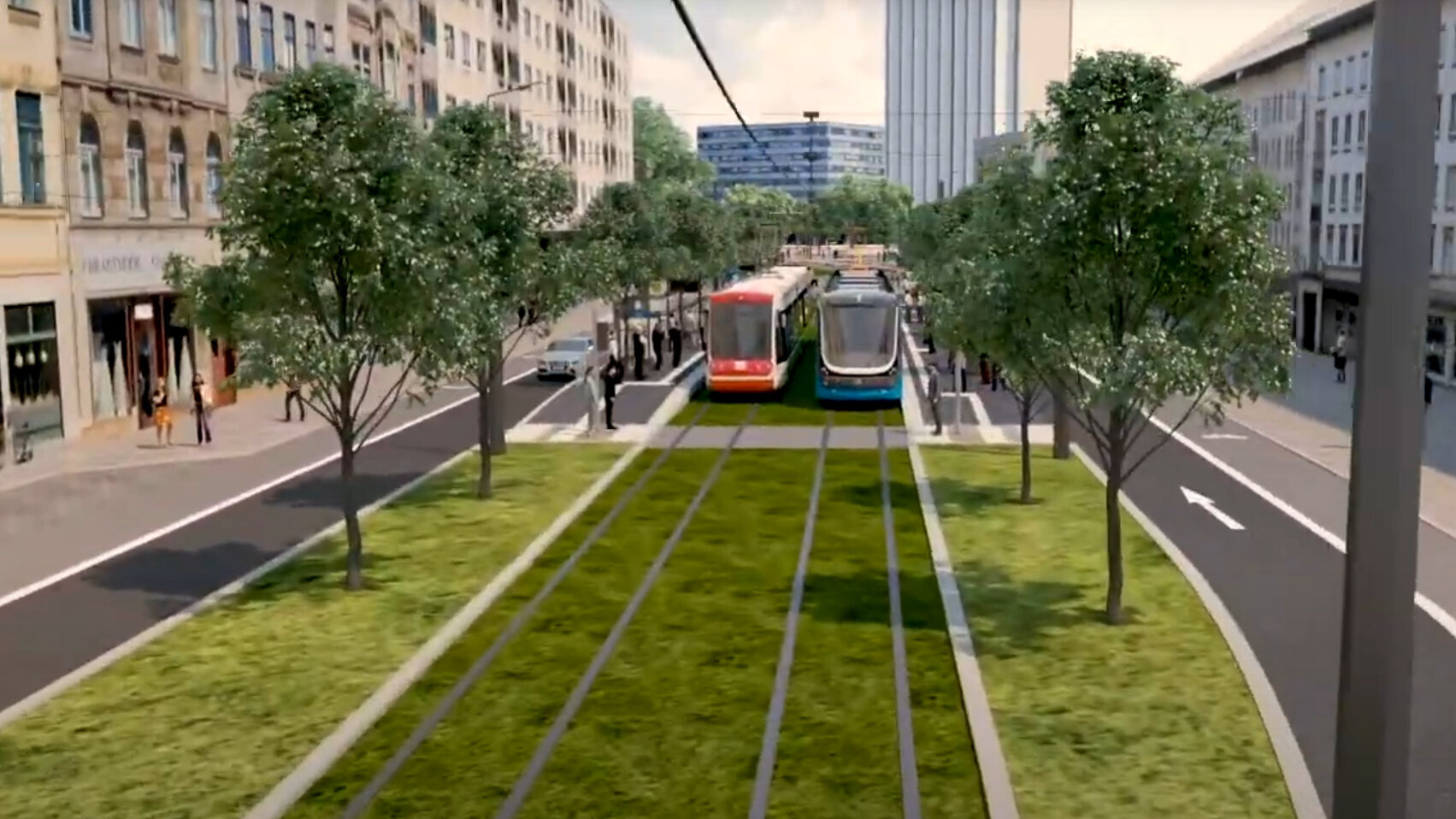
The start of construction of the CM4 marks the beginning of the urgently needed further development of local rail transport in Chemnitz. In particular, the completion of the railway ring along Theaterstraße and Brückenstraße will significantly increase operational flexibility for CVAG trams and the Chemnitz Model trams and further improve accessibility to the city centre. This strengthens public transport as an important pillar of mobility.
The individual construction phases for the city centre ring road over the next few years

| No. | Designation | Construction period |
|---|---|---|
| 1 | Falkeplatz | 02/2026 - end of 2028 |
| 2 | Centre ring 1: Mühlenstr. | 02/2026 - vsl. 06/2026 |
| 3 | Zentrumsring 1: Theaterstr. from Brückenstr. to Hartmannstr. | vsl. 06/2026 - vsl. 11/2026 |
| 4 | Zentrumsring 1: Theaterstr. from Hartmannstr. to Kaßbergauffahrt | vsl. 11/2026 - vsl. end of 2027 |
| 5 | Zentrumsring 2: Theatre street from Kaßberg driveway to Falkeplatz | expected from the beginning of 2028 |
| 6 | Centre ring 2: Brückenstr. | expected from spring 2029 |
| 7 | Centre ring 2: Bahnhofstr. | expected from autumn 2029 |
| 8 | Hartmannstr. from Theaterstr. to Fabrikstr. | expected from the beginning of 2028 |
| 9 | Hartmannstr. from Fabrikstr. to Leipziger Str. | expected from autumn 2029 |
At the same time, the entire public space will be significantly upgraded. The dividing effect of the affected streets will be significantly reduced and road safety will be increased thanks to modern and safe cycle and pedestrian facilities throughout the area. Synergy effects can be utilised by implementing several so-called interrelated measures. This also applies to Mühlenstraße, for example.